Base8Ball brings America's pastime into the digital age, more than fifty years after it first arrived on the tabletop. It's a hat tip to Jim Barnes and the creators of Avalon Hill's Statis Pro Baseball.
A ticket to the show
Baseball has always been the best sport at remembering itself.
The first big-league game I ever saw in person was sometime in the summer of 1977 when the Indians paid a visit to Arlington Stadium to take on the Texas Rangers. Major League Baseball was still trying to find its footing in Dallas-Fort Worth back then because the Metroplex was at the center of the massive blast radius created by the Dallas Cowboys. The Rangers were maybe the third pro team I'd ever seen in person, behind the Cowboys and the Harlem Globetrotters. Even with a morning and an afternoon paper, baseball news was hard to come by, and the Rangers almost never turned up on TV.
Long Island comes to the suburbs
But my interest in baseball ramped up quite a bit when my family moved to the 'burbs during my junior high years. That's when I befriended a couple of kids from Long Island, Gary and his kid brother Mark, two of the coolest and most talented people I've ever known. Mark has a knack for all things mechanical and is as easy-going as they come. Gary is creative and an excellent artist and a pop culture encyclopedia. Through Gary, I met his friend Mike back in New York, whose interests run from sports to technology. The eighties were a great time to be a kid. The music was terrific, the summers were long, and even if our pro baseball teams were below average, there was plenty of Wiffle ball to be played in the streets, lawn chair catcher and all.
We had a big strike zone that included the back legs. If you could "tink" 'em, it was a strike.
Gary and Mike are die-hard Mets fans. Mike played a tabletop baseball game called Longball, and somewhere along the way Gary discovered Avalon Hill's Statis Pro Baseball. Jim Barnes had designed the thing back in 1970, naming it for a newspaper column he wrote in Iowa. The whole engine ran on an octal, or "base 8," number system: 11 through 88, nothing ending in 9 or 0. That quiet piece of math is where our name comes from.
We decided to test our budding managerial careers with what passed for a "season" in those days: 26 games a team. Everything was tracked in pencil and paper, which competed with our passion for the record store, the movies, and Wiffle ball, so there was no way we could have simulated 162 games per team over a summer break.
So there'd be no Mets/Rangers bias, I managed all the National League teams and Gary skippered the American League. He had the DH, I had Astroturf speed. Cable TV had just reached the suburbs, so while I could only catch the local nine on the radio most of the time, I had a steady diet of the Braves on WTBS, the Cubs on WGN, and the Mets on WOR, which meant I saw every other NL club, too, as they rolled through.
The ritual
The Internet didn't exist, we were still decades away from anything resembling Amazon, and Walmart had yet to make its way to our neck of the woods, so finding the updated player cards from year to year was a challenge. We’d resort to calling department stores, book stores, purveyors of fine sports memorabilia, and anyone we thought might have a copy or two of Statis Pro. Once in hand, we'd spend hours separating the perforated sheets of player cards, stacking them by team, and studying each player through the game's "base 8" lens.
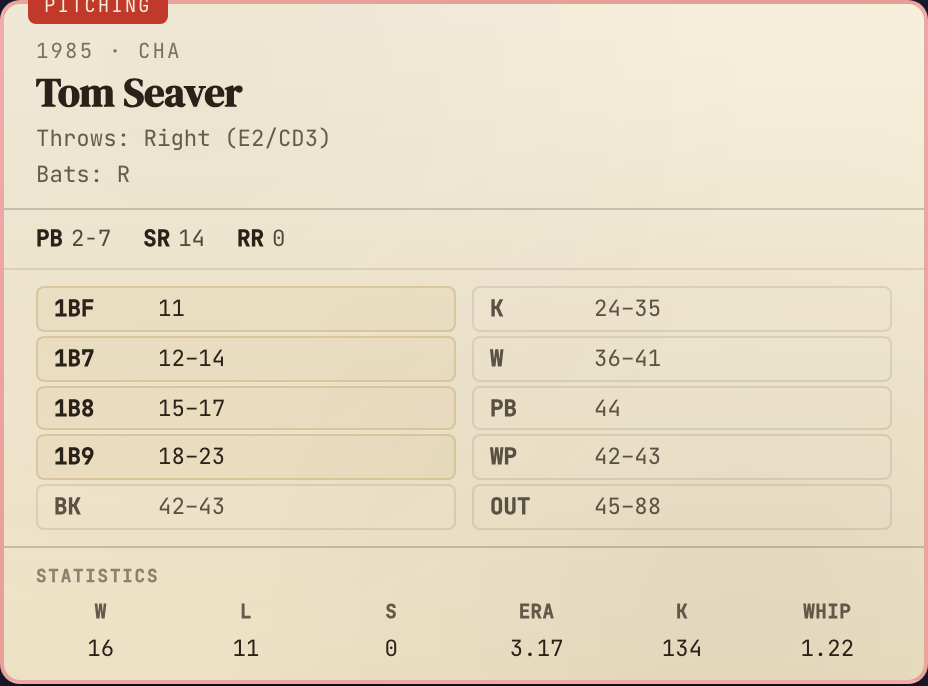
The Dallas Morning News and the Dallas Times Herald kept us informed about the stars of Major League Baseball. But while most folks spoke in terms of batting average and ERA, we expanded our baseball vocabulary with phrases like "Tom Seaver's a 2-9 this year" or "George Brett has the smallest K-rating I've ever seen." You knew early whether a team would be a slog to manage by counting the "2-5" starters in its rotation, and if your power club drew one of those, you were in for an afternoon of pitching changes. That meant longer games, cluttered scoresheets, and less Wiffle ball. Anytime I saw the Padres or Giants of that era on the schedule, I knew it would be a long day.
We never considered the impact of an injury-shortened season. Sometimes it reduced an otherwise great player to a mediocre card; other times it made him superhuman, a hot month frozen in cardboard. Regardless, we soldiered on with the help of Street & Smith’s, Baseball America, newspaper previews, and anything else we could find each spring. Somewhere along the way we stopped simply playing a game and started learning how baseball statistics tell a player’s story.
Then & now
The same player, forty years apart
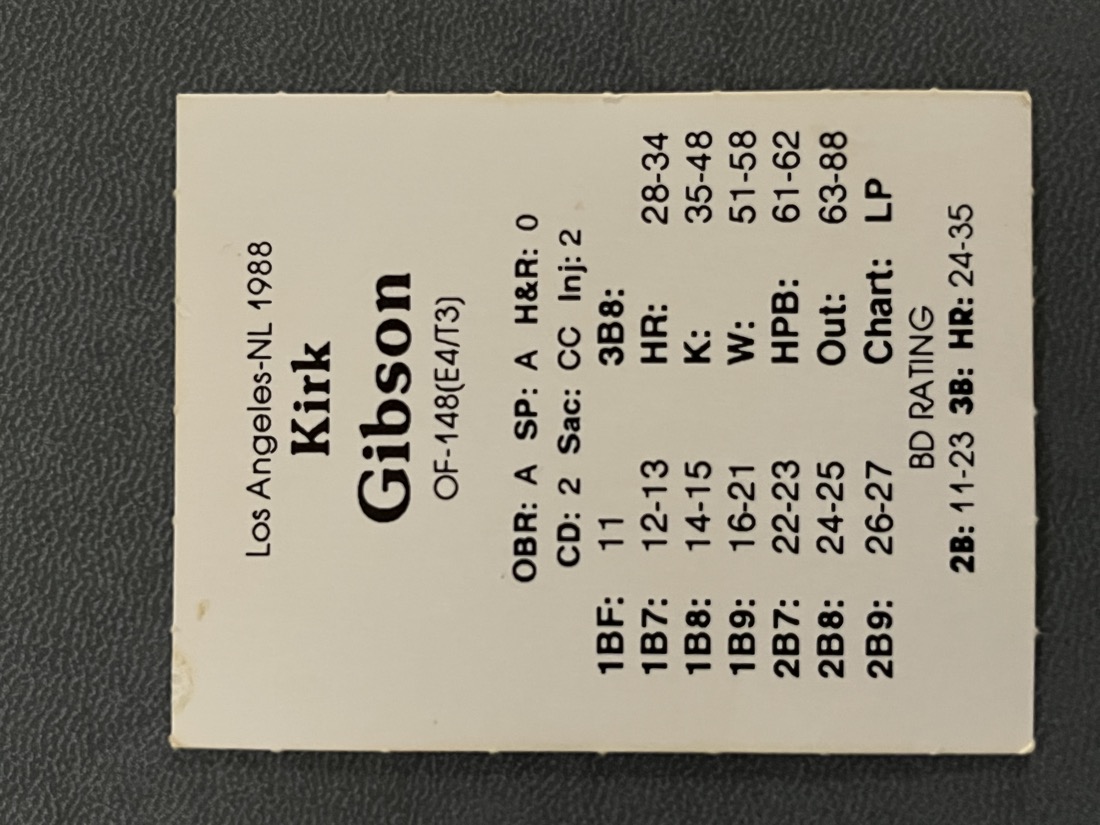
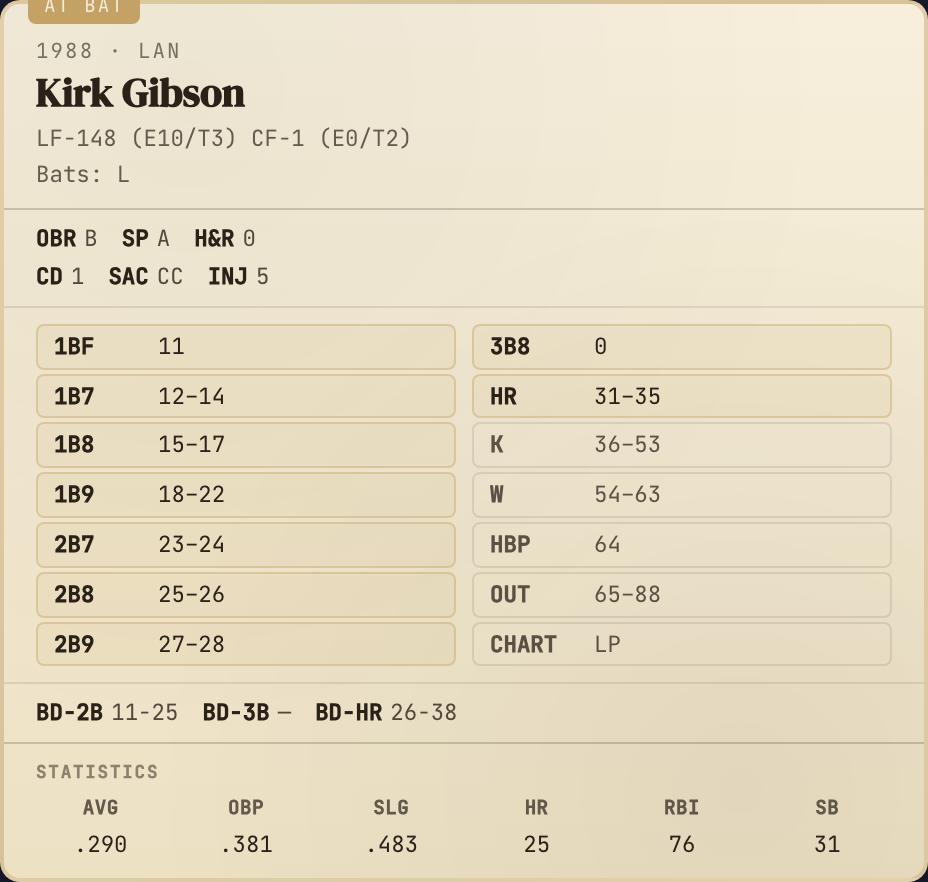
The original, a worn Kirk Gibson card from the boxes I grew up on.The reboot, the same season, rendered by Base8Ball's own engine.
The benefit of a 26-game season is that every team is in the hunt until pretty late in the campaign. But it was always a great feeling to have reached the postseason, pitting your best teams against one another, and eventually crowning a league champion that would face the other guy’s best of the bunch.
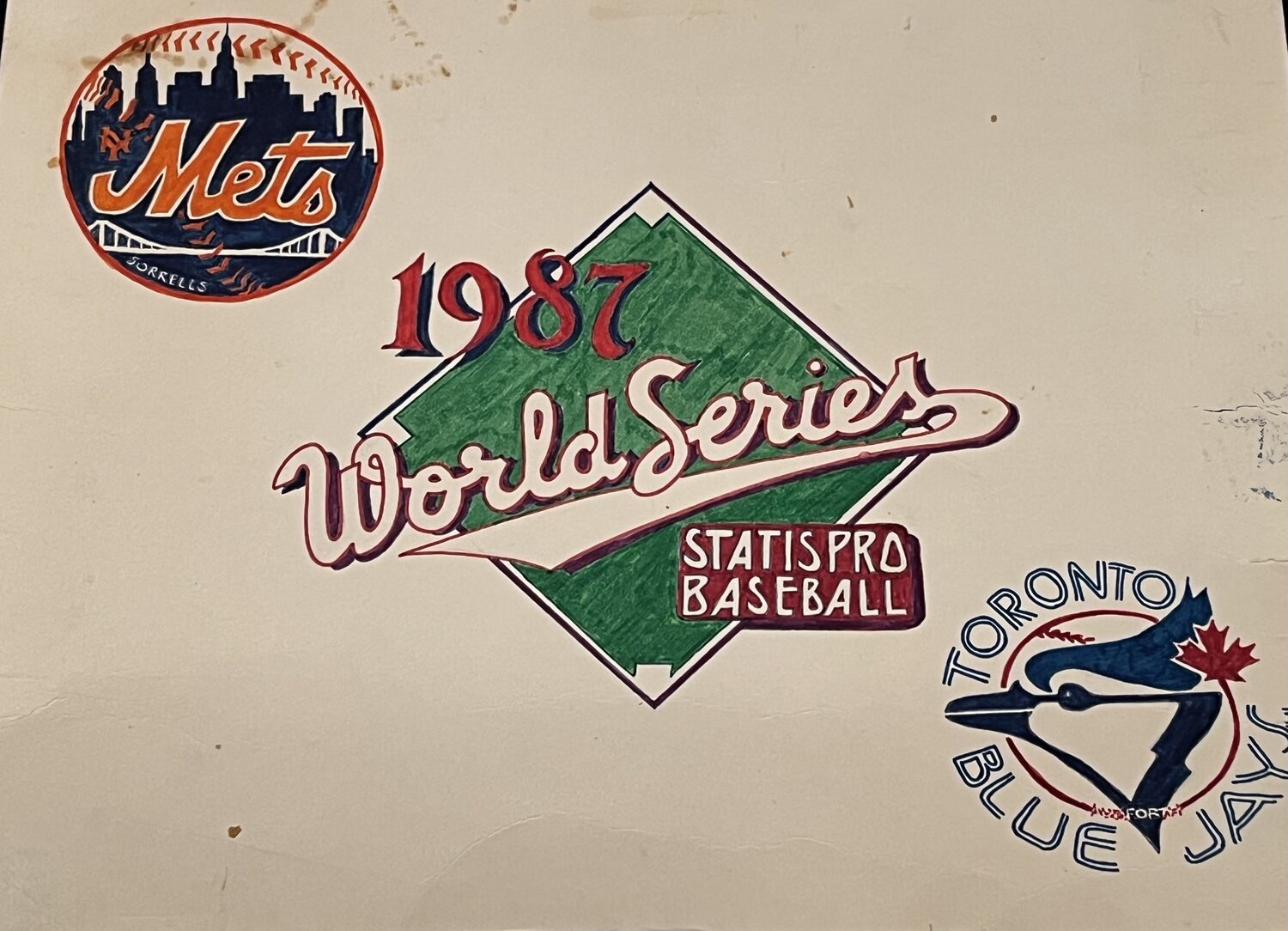
Gary's always been a terrific artist, and he'd draw elaborate logos to commemorate each World Series. I was the computer kid. With a trusty VIC-20 and a cassette drive, I built a form to move the scorecard into a database and printed after-game stats on a dot-matrix printer which, coincidentally, would become some of the tech I'd soon use in my professional career.
One of Gary's hand-drawn World Series logos — our 1987 Fall Classic, in ink and marker.
I'm not sure I ever beat Gary in our version of the Fall Classic, even the year he had to take on the '86 Mets. But we kept at it for years, well into early adulthood, until Fast Action Cards and K-ratings and Rickey Henderson's "automatic steal of second" (literally stamped onto his card) finally faded behind college, careers, and other interests.
The press-box years
Rather conveniently, I convinced my parents that it would be a good idea to let me complete my college years at The University of Texas at Arlington, which led to a job as a producer on the Texas Rangers Radio Network. That meant countless nights in the back of the booth with the great Mark Holtz and future Ford C. Frick Award winner Eric Nadel.
The Rangers eventually moved off our flagship station but my career in sportscasting kept me in press boxes long after. It was in an NFL press box, the brand-new Jack Kent Cooke Stadium outside Washington, DC (in Raljon, Maryland, the site Cooke had renamed for his sons), that I struck up a conversation with the Fort Worth Star-Telegram's longtime columnist Gil LeBreton. Gil pulled me into his circle of media pros playing Diamond Mind and, later, Action PC Baseball. They were beat writers, columnists, and if they weren't in the media, they were baseball savants. Just like my Statis Pro days against Gary, Gil's crew beat my teams with regularity for years. It was a blast anyway.
Gil's leagues had many iterations but the same nucleus of participants stayed together for years. And why not? We were probably the only sim league on the planet that had its annual draft in the press box at The Ballpark in Arlington, marathon-long sessions that involved late night pizza, good-natured trash talk (most of the time), and the hope that this was "the year" we would finally win the league championship.
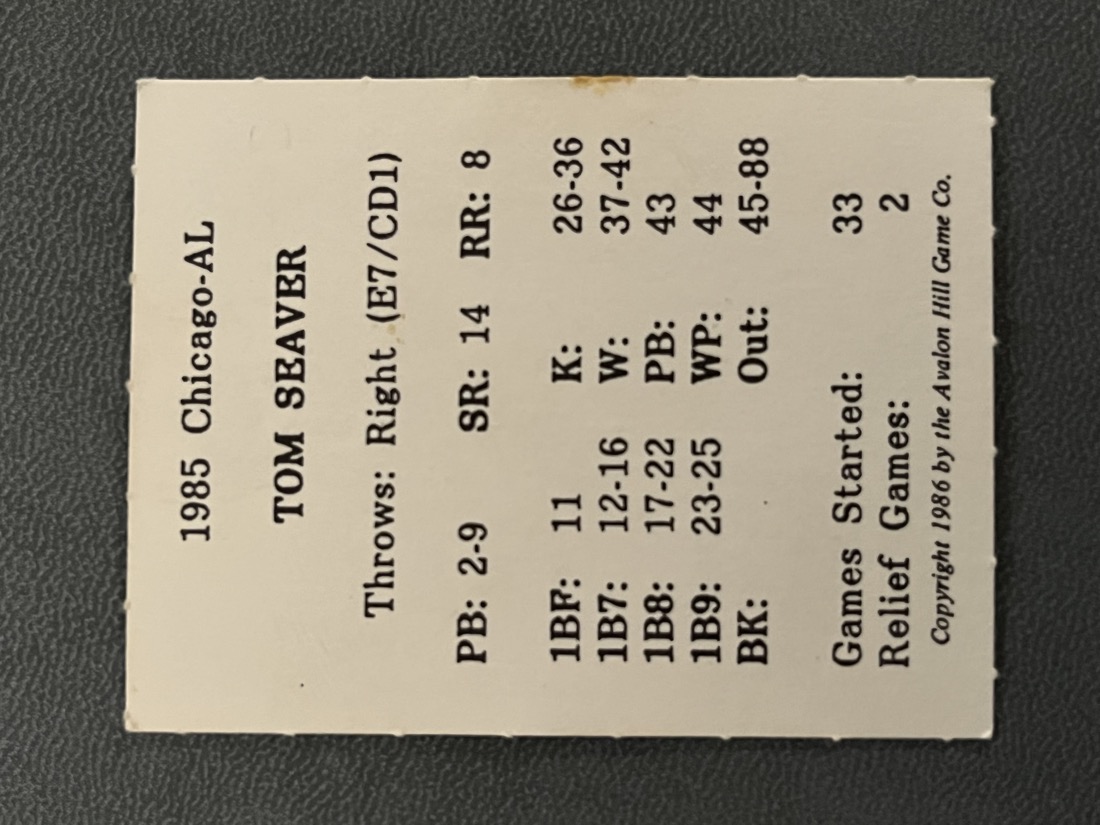
Tom Seaver, as the cardboard remembered him.…and as Base8Ball builds him today, straight from that season's stats.
Thirty years later
Somewhere in the middle of all that, my kids found the tattered, much-loved Statis Pro boxes from my younger years. They pored over the aged cards and worn charts, and despite growing up in the era of console games, they wanted to play this tabletop relic. This was the Josh Hamilton era and every young Rangers fan was paying attention to baseball. My full-time broadcasting career had turned into a seasonal studio-host gig with the Dallas Stars by night and information technology by day. So, with my kids as the stakeholders, I wrote a script to generate a fresh set of player cards, the first new cards to touch that Statis Pro gameboard in well over thirty years. Avalon Hill hadn't printed a card since 1992, and enthusiasts had kept the game alive by making their own from the instructions in the box. The engine was still there, and it was still fun.
A tribute, made our own
What started out as a return to yesteryear on behalf of my kids eventually turned into a "can I make an online version of this game" project of my own. Base8Ball is the culmination of that effort. For longtime Statis Pro fans, I've tried to honor the spirit of the original, the Z-chart swings and all the beautiful chaos that made it what it was. But I learned quickly that when you can simulate a full 162-game season in a sitting, that chaos gets magnified: the old game ran hotter than real baseball on ejections, injuries, even rainouts. The likely reason is that it was built to hand you a whole-season experience every time you played, a box of chocolates in cardboard form.
So our version ships with two engines: one that leans into that classic feel, and one tuned to modern MLB percentages. Both support things that didn't exist forty years ago, like the extra-innings ghost runner, mound visits, even an automated ball-strike challenge system, each toggled by the commissioner, so every league can be its own thing. We've also tried to take the headache out of running a league: games can auto-play at whatever interval the commissioner sets, so the season moves even when managers are away. A strict "auto-GM" steps in to fill gaps (say, when a player's usage is spent and no replacement was named), and trades can be set to auto-approve within a window, so a deal both managers already agreed to goes through on time even if the commissioner's tied up.
A word for the purists: Base8Ball is inspired by Statis Pro Baseball, not a replica of it, and it won't be 100% faithful to every chart and corner case. What we hope you'll find is the joy of those pencil-and-paper seasons, and a new way to enjoy the game.
Base8Ball is a tribute to the game we all love, and to the game we grew up with. It's a tribute to Jim Barnes, who created Statis Pro Baseball, and to the many other tabletop and online baseball games before and since. It's a tribute to the friends and family who played those games with us, and to the memories we made along the way. And it's a tribute to the game itself, which has been woven into our American sports tapestry for well over a century. I said at the top that baseball is the best sport at remembering itself. Base8Ball is my way of helping it remember.
More than fifty years ago, Jim Barnes turned a newspaper column and a deck of cards into a whole season of baseball you could hold in your hands. Base8Ball is our attempt to carry that feeling forward. Same love of the game, new century.
Play ball
Take the field.
Create a free account and play your first game today, no app to install, right in your browser.